The Latest
 July 2, 2025 - Spent most of June in the San Bernardino Mountains, staying in Moonridge specifically and going out everyday. I'm working on what could eventually be a book about the butterflies of the Big Bear area. Not just identification, but rather an emphasis on the ecological context (so plant associations, life cycle timing, fooling predators, etc.). Long story. Most of my attention has been going towards that project, but for now on this website, here's a few new things: on the hedgerow hairstreak, there is an egg photo from Lake Arrowhead; on the page for the hoary comma scroll down for both an egg and a caterpillar; and for Leussler's branded skipper there's an egg as well. The latter egg surprised me with its texture and I think it's really cool.
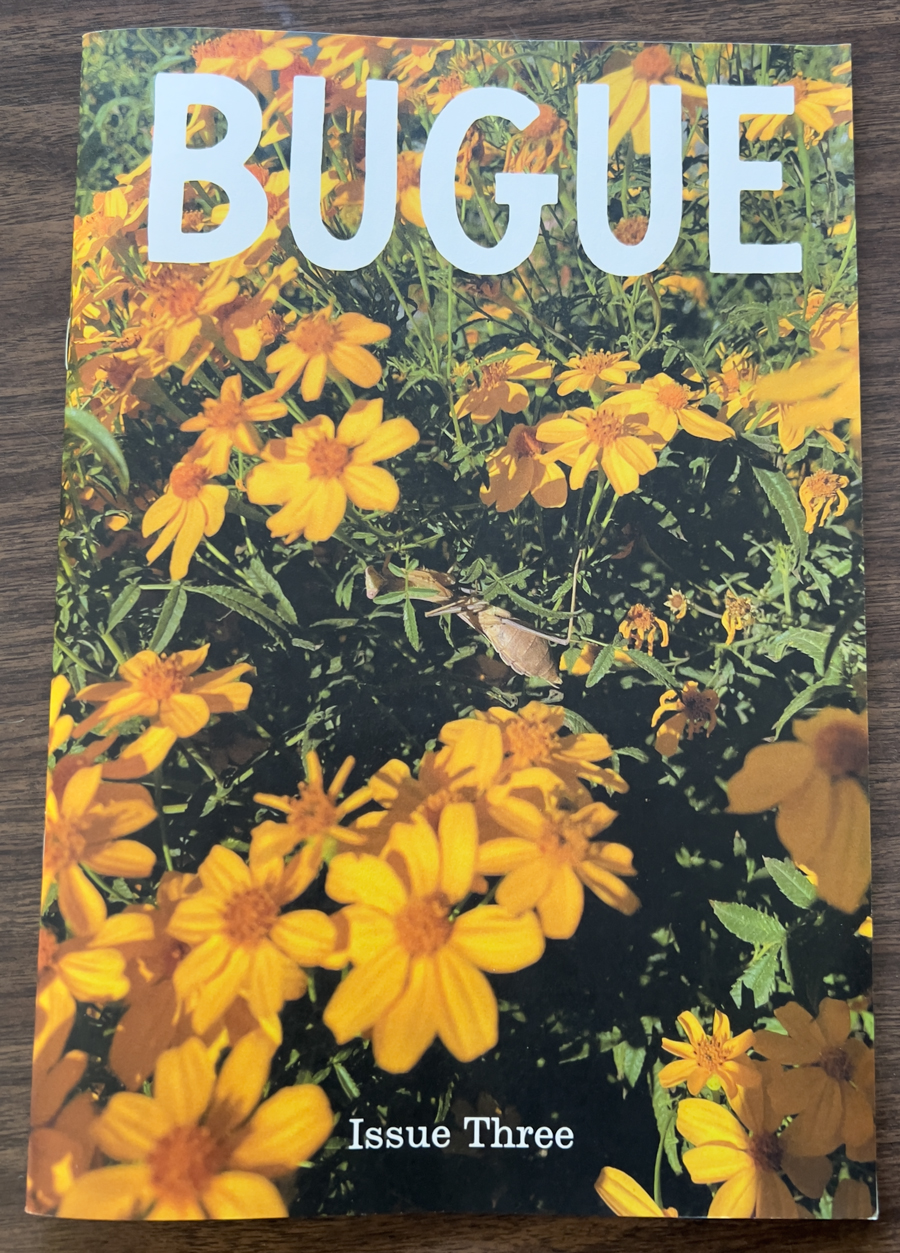
May 24, 2025 - Bugue Magazine is the brainchild of talented illustrator and garden afficionado Liana Jegers. All three issues she's created so far are really well done. If you pick up the latest issue - number 3 - there is a short article I wrote with nice illustrations by Liana. So do yourself a solid and click on the image above and get caught up on all the big news from Liana's garden, which - I promise - has many cool bugs!
I've also added a photo of the chrysalis of Moss's elfin, which completes the documentation of the lifecycle here.
May 4, 2025 - The caterpillar of Moss's elfin is small and becomes bright red - odd for a butterfly that is rather drab as an adult. It also feeds on a colorful succulent, Sedum spathulifolium. Check out the egg, too.
April 27, 2025 - I've been out in the field a lot lately as the butterfly season has finally begun to get underway. I have some new photos of Moss's elfin, thanks to Seth Mueller, who found them flying several days ago. Overall, this has been a poor year for butterflies because of very dry conditions. Some places are better than others, with the deserts having received little to no rain for about a year. Lower to middle elevations of the San Bernardinos and San Jacintos are much better but still below normal for butterfly activity. Perhaps this is a year we get good summer rains.
Here is a pdf for those looking for information about our book on the Butterflies and Skippers of Joshua Tree National Park. To order, click here. It's available at select bookstores as well, including the kiosks at the National Park itself. If you have questions, email me at denbugg AT hotmail.com.

September 2, 2024 - I've corrected a few things on this site - nothing major. I'm thinking of replacing the Resources page and maybe the Gallery page with a pretty thorough History page (probably some time next year). This would be about the history of our knowledge of southern California butterflies going back to the gold rush era, and I would love Native perspectives as well, for obvious reasons. In preparation, I've already typed out and partially translated Boisduval's long 1852 article on the butterflies he was receiving in Paris from Pierre Lorquin. Lorquin had come to San Francisco ca. 1850, and collected over several years in places including an important trip to the foothills of Los Angeles. Much of what he was finding was new to science. In the ensuing decades, a home-grown scene developed, with some real characters scouring the mountains and deserts for treasures. It's a story worth telling well, so I'll take my time with it, and as with the rest of the site, let it develop over time.
July 28, 2024 - Added a few photos to flesh out the Apodemia virgulti mojavelimbus page. I felt I needed to show the population from the eastern end of its range in Joshua Tree National Park.
May 15, 2024 - Things are hopping out there. After several days in the deserts and mountains, I've added photos (not all eggs!) to a few pages: Leanira checkerspot, Melissa blue, Boisduval's blue, arrowhead blue, Arizona powdered skipper, white checkered skipper, and northern white skipper.
April 26, 2024 - I was able to get microphotos of the egg of an Arizona powdered skipper at 228x magnification. Gordon Pratt gave me the egg on a leaf of hollyhock, and I'll attempt to rear it. I haven't added any other photos lately, and haven't gone out into the field much, but May should be very good in southern California for butterflies.
March 30, 2024 - I've wanted better photos of the Loki juniper hairstreak, and found a fresh one at Cactus Spring Trail that obliged. I visited Plum Canyon in Anza-Borrego again, and have added better photos of the Arizona powdered skipper, plus a final instar caterpillar of the California patch showing more detail than what was there before.
March 12, 2024 - The butterfly season is just getting underway across southern California. A trip to Plum Canyon in Anza-Borrego on a beautiful, cool, and quiet day looked like it was going to be a wash (no pun intended) when - finally - the clouds allowed the sun to peak through and warm things up. First on the wing was a fresh male desert orangetip, and within a minute or so I found a final instar California patch caterpillar, which I've been wanting to photograph. The only other leps were a funereal duskywing, a Wright's metalmark, and a small blue that looked like acmon but flew off before I could tell for sure. I didn't see whites or sulphurs along the roads as I drove for hours, either, so this really is a late-starting butterfly season.
December 14, 2023 - I finished revising the last of the skipper pages after doing a deep dive on duskywing skippers. So that's it for the individual species pages: all should now have a new look at the top with a brief intro. This was a fun learning experience, digging in everyday for about two months to go through the older pages, writing and combing through photos. Things are now more up-to-date and thought through for certain groups, such as the Apodemia mormo complex, the Erynnis skippers, and others. Name changes over the past few years based on genomic sequencing have been hard to keep up with, and a bit of a pain when obsolete names are all over your html pages and file names!
December 3, 2023 - I've revised a lot more pages, including all the whites and sulphurs and metalmarks, so that's four of the six families. Most of the nymphalids are done, and the skippers will be last.
November 20, 2023 - Everyday I've been doing at least some work on updating the species pages, and today I finally finished all the coppers, hairstreaks, and blues. Swallowtails have been done for some time, and whites and sulphurs will be completely done soon. It will probably take another month or two to do the whole site if I do a little every day.
November 6, 2023 - I've updated several pages and will try to do several a week now that we're getting into the off-season. Lately, I've added to the western pygmy blue page, and remade the pages for sonoran blue, echo blue, cinereous echo blue, marine blue, funereal duskywing, and Harford's sulphur. This involves the headers and brief "article" at the top, possibly updating photos if need be, and I like to add the original description if I can. I think this makes for a more complete page for each species.
October 24, 2023 - This butterfly year is showing some remarkable staying power. I had a great day in the San Jacintos hiking the Cedar Creek Trail and saw a lot of butterflies between the trailhead and the meadow. I found Mylitta crescent eggs on a thistle leaf, and decided to revise that page, which I'd like to do for all the pages here as I get a chance. It's a bit of work; I add a header, some verbiage, and often look for better photos, plus I try to track down the original description. I really like to get good shots of the eggs, caterpillars, and chrysalises, since even as I type this, every species that flies at, say, Cactus Spring Trail is there right now, even the spring flyers; they may not be in the adult stage, but they are there.
October 12, 2023 - I've revamped the western pygmy blue page, with a different ventral photo, an egg and first instar caterpillar, and the original description. I also have added egg photos (using my microscope camera) for the painted lady and Afranius duskywing.
September 30, 2023 - Just spent a few days in Borrego Springs and really enjoyed the surrounding Anza-Borrego Desert State Park. I used to go there a lot when I was fairly new to this. When I was a kid, places like Scissors Crossing and Plum Canyon were legendary spots I had only dreamed of visiting. I ended up going to Plum Canyon twice, taking advantage of a population explosion of tiny checkerspots to shore up the life cycle photographs. I had some shots from the book project, but still no eggs. Now I would be able to find a few caterpillars, a few pupae, and even watch a female ovipositing, all amid tens of thousands of fluttering adults. So, I spent some time completely redoing the page for the tiny checkerspot, now known as Microtia dymas imperialis. I also decided to make a new page for the Afranius duskywing.
September 19, 2023 - One of my better caterpillar photos is this one of the common buckeye, which I'm raising from eggs. On the American lady page, I added a photo of a typical caterpillar that I currently have at home. Both species have really beautiful caterpillars.
September 10, 2023 - The purplish copper is a beautiful butterfly. I found an egg the other day by searching the dock plants in their habitat, and I've added a chrysalis photo to complete documentation of the life cycle. I was lacking photos of the egg of the desert black swallowtail as well, but a female at Cactus Spring Trail was kind enough to oviposit right in front of me. Two stops on the same day, two eggs to complete these life cycles: pretty good day.
September 1, 2023 - I got a good shot of an amazing caterpillar, the desert metalmark, on desert trumpet at Rattlesnake Canyon. This species was the only thing flying, and I came upon two larvae as well. The scale broom was just barely beginning to bloom here and there. At Lake Hemet a couple of days before, I found a better Colias eurytheme egg on Acmispon americanus, so I replaced a photo on that page. Am I sure it was an orange sulphur? Yes, I watched the female ovipositing. The same thing happened the next day at Lake Cuyamaca, except the butterfly was a buckeye. I needed photos of this one to complete the life cycle, so that was nice. I find that the immature stages sometimes are more interesting photographically than adults, but much more challenging.
August 25, 2023 - The page for Colias eurytheme has now been redone, with a couple new photos of adults, eggs, and a caterpillar and chysalis. I left two photos from 2007 and 2008, since they weren't bad. I also added the brief original description by Boisduval in 1852 from a French journal and translated it. The butterfly is found all over North America, but Boisduval named it from a California specimen he received from Lorquin, who was collecting during the gold rush. I think he got more butterflies than gold.
August 20, 2023 - Waiting out the hurricane (what???) and decided to revamp two pages that needed it: the California dogface and the southern dogface. There are some new photos there. Also, I was at the beautiful Bluff Lake Reserve and watched a female greenish blue place an egg in the flower head of the clover it uses there (T. wormskioldii). I took the latter egg to photograph with my microscope.
July 25, 2023 - My remaining purplish copper caterpillar is a fourth and final instar now.
July 19, 2023 - I have a lot of photos to go through, including many immatures not yet on this site. For now, here's an interesting group of eggs of the gorgon copper, and an egg of Lorquin's admiral, which is very interesting looking. And two caterpillars: a purplish copper from Big Bear, and Gabb's checkerspot from Volcan Mountain.
July 3, 2023 - Returned to find mature caterpillars of Euchloe andrewsi. Interestingly, they were actually on a different species of Streptanthus than the classic bernardinus. And I watched an Acmon blue oviposit, so here's a microscopic view of the egg.
June 30, 2023 - I found caterpillars of a pretty rare butterfly: Euchloe andrewsi, on their food plant, Streptanthus bernardinus. So there is a new species page, though without adult butterfly photos. I've also added a chrysalis of a red admiral that I was rearing.
June 11, 2023 - I've added caterpillar photos to both the red admiral and west coast lady pages, so I now have on the website caterpillars of all four Vanessa species. I planted hollyhocks a few months ago in order to attract the west coast ladies, and I went to a good nettle patch near Idyllwild for the red admirals. It seems that a natural progression for people who get interested in butterflies is that they focus on the adults almost exclusively for a long time, and come to realize the importance of the larval food plants, at first as a way to find the adults. The next step for some involves the life cycle: eggs, caterpillars, and chrysalises, which are harder to find but really fascinating. Information about how many broods, stage of overwintering, etc. gains importance as you go deeper. And you can go very, very deep. At least, that's how it's been for me.
May 29, 2023 - Went to Santa Barbara and San Luis Obispo counties and found a new one for me: the small blue from the Lompoc area named Euphilotes speciosa purisima. While I was leaving there I noticed a west coast lady ovipositing on apricot mallow, so I got some photos of the egg. I've been photographing caterpillars of what I'm reasonably sure are west coast ladies, but in the early instars especially they are easily confused with painted ladies, so I'll rear them to adults to be sure. I probably have scores of photos of both species from the last month, and I'm interested in the differences of their immature stages, so I should have something on that here eventually. After getting the small blue in Lompoc, I moved on to the Elfin Forest in Los Osos, San Luis Obispo County. There I found a few fresh Satyrium saepium caliginosum, which are on the local ceanothus shrubs, a subspecies with a very limited distribution. I've seen something close to these a few miles inland but this is the real deal. I also visited Gordon Pratt and came home with some goodies; I've been updating some pages as well, so check out the Sara orangetip page, which now has all four stages; the Behr's hairstreak (not really updated except that I added a cool caterpillar); and the desert black swallowtail, to which I've added the brown-form pupa.
May 7, 2023 - Lots going on in our deserts and the mountain foothills. I've updated the page for the gray marble - Anthocharis lanceolata australis - with a shot from Seven Oaks near Big Bear from a recent daytrip. I've also changed out the photos and revamped the page for the dainty sulphur - Nathalis iole. I added photos of an egg and a chrysalis as well.
April 5, 2023 - Updated the page for Neumoegen's sagebrush checkerspot. So far things look to about a month behind out in the deserts, but things are picking up.
March 17, 2023 - This promises to be a fantastic year for butterflies in southern California due to the regular rainstorms we've been getting. When it warms up I expect to be out regularly, particularly in the deserts. In the meantime, here is a chrysalis of the desert black swallowtail, given to me by Gordon Pratt the other day. This species of swallowtail was hilltopping at Cactus Spring Trail early in February during a relatively warm period. Caterpillars of checkerspot Euphydryas chalcedona had also emerged to resume feeding on the Keckiella. But just as the area was beginning to stir, a new wave of storms and freezing temperatures hit the area. But April to June should be fantastic there.
Our book on the butterflies of Joshua Tree is officially available, and the feedback has been fantastic. For the time being, I'm trying to avoid selling it on sites such as Amazon and would prefer to sell directly. It's also available at the Joshua Tree National Park kiosks (see above!), such as the one on Park Blvd., and is also available at several other small bookshops.
Click on the image above or here to order.
Written by Dr. Gordon Pratt, this book covers the National Park and environs. Legendary lepidopterist Dr. Paul Opler contributed the preface, and there are approximately 620 photographs; I contributed ca. 500 of them, designed the book, and oversaw the printing process. Joe Zarki - who worked for years at the National Park as a ranger involved in public education - added his expertise as the book's editor. Much of the research in both the field and lab involved the late Dr. John Emmel, whom Gordon worked closely with for decades. Photographs were also contributed by Gordon and Joe, as well as Jim Brock, Greg Ballmer, June Marjorie Pratt, Alice Abela, Greg Chatman and Gene Hanson.
Here's a sample spread that's pretty typical. There is a lot of information on larval food plants and the immature stages of 98 species. Besides an Introduction, there are also separate discussions of Euphilotes blues and the mormon metalmark complex in our area, topics on which Dr. Pratt is the leading authority. This project is something we've been working on for a few years, and we are happy with how it turned out. It's much more than just a guide, especially since Gordon sees butterflies as more than just the adult stage, and thus there is detailed information on the life cycle as a whole, strategies to get through the freezing winters and times of heat and drought, as well as the plant relationships crucial to each species. So while it is a useful guide for those seeking to identify butterflies in the Joshua Tree area (and there are a lot of tips on telling apart similar species), it is also a valuable resource for those who wish to go deeper. And, of course, much of what one learns about butterflies in this area will translate to butterflies elsewhere, even in our own backyards.